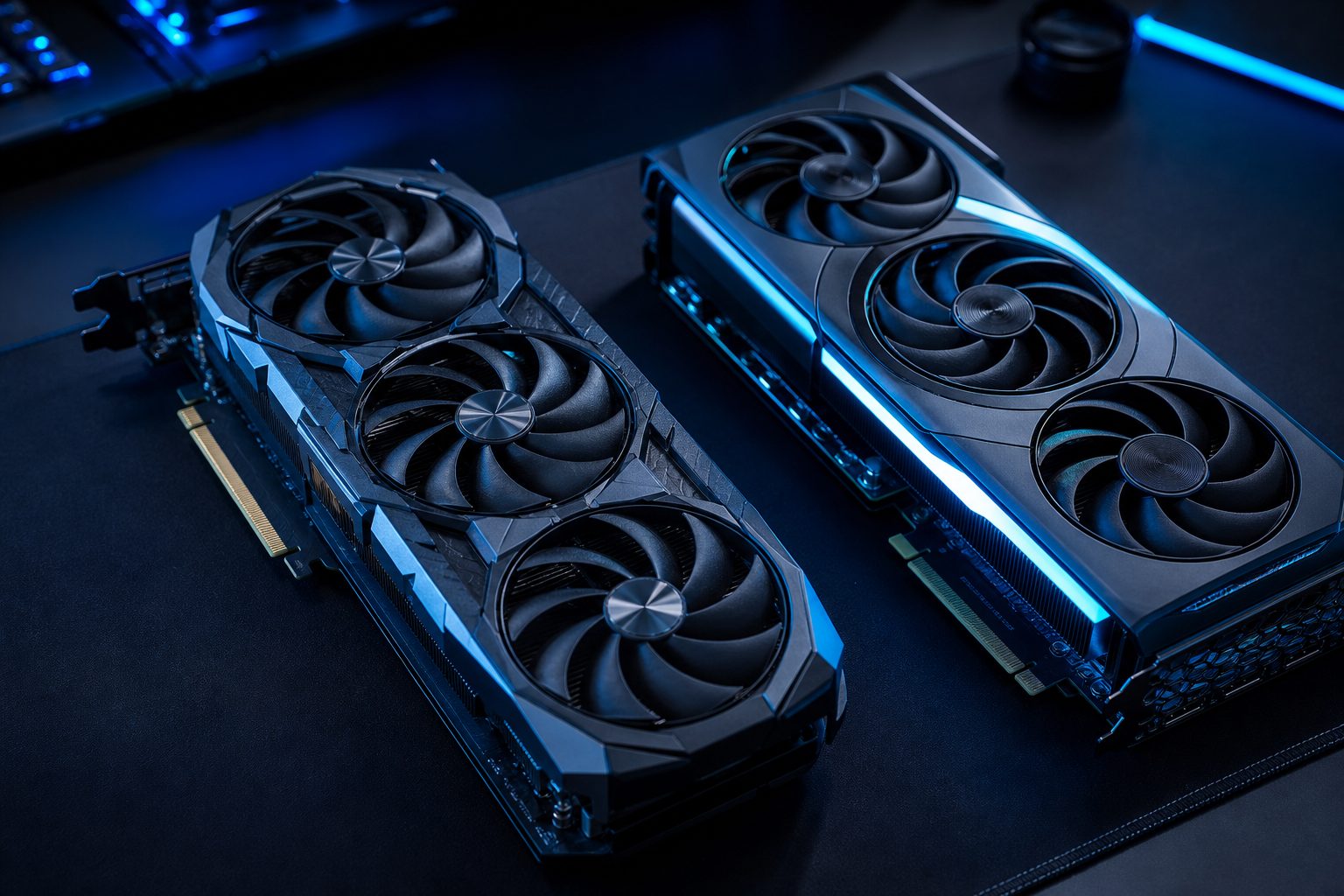
RTX 4070 Super vs RX 7800 XT: The Ultimate 1440p GPU Showdown
Choosing the right graphics card for high-resolution gaming can be a significant decision, especially when targeting the popular 1440p sweet spot. The comparison of the RTX 4070 Super vs RX 7800 XT stands out as a key battleground for gamers seeking excellent performance without breaking the bank.
These two powerful GPUs from NVIDIA and AMD offer compelling features and capabilities designed to deliver smooth, immersive experiences at 1440p resolution. Understanding their strengths and weaknesses is crucial for making an informed purchase. This article delves into a detailed comparison of their specifications, gaming performance, and feature sets to help identify the ideal 1440p GPU for various gaming needs.
Core Specifications and Pricing for the 1440p GPU Contenders
Before diving into performance metrics, a look at the foundational specifications and current market pricing provides essential context for the RTX 4070 Super vs RX 7800 XT debate. Both cards are built on modern architectures, but they approach performance and value from slightly different angles.
Understanding the hardware under the hood helps explain their varying strengths in different scenarios, from raw frame rates to advanced rendering techniques. Pricing also plays a critical role in determining overall value, especially in the competitive mid-to-high range GPU market.
NVIDIA GeForce RTX 4070 Super Overview
The NVIDIA GeForce RTX 4070 Super is a refreshed GPU from NVIDIA’s Ada Lovelace architecture, positioned as a strong performer for 1440p gaming. It features 12GB of GDDR6X VRAM, which is generally sufficient for most modern games at this resolution, though some titles at maximum settings might push its limits.
This card boasts a significant increase in CUDA cores and Tensor Cores compared to its non-Super predecessor, leading to improved rasterization and exceptional ray tracing performance. It also benefits from NVIDIA’s advanced DLSS 3 technology, including Frame Generation, which can significantly boost frame rates in supported titles.
AMD Radeon RX 7800 XT Overview
The AMD Radeon RX 7800 XT, based on the RDNA 3 architecture, aims directly at the 1440p gaming segment with a focus on raw rasterization performance and a generous VRAM allocation. It comes equipped with 16GB of GDDR6 VRAM, providing a substantial buffer for demanding textures and future-proof gaming.
AMD’s offering often provides competitive or even superior traditional rasterization performance against the RTX 4070 Super in many titles. While its ray tracing capabilities are strong, they typically lag behind NVIDIA’s counterparts. The RX 7800 XT leverages AMD’s FSR 3 upscaling technology, which also includes Frame Generation, offering an alternative to DLSS.
Pricing and Market Position
Historically, the RX 7800 XT has been positioned at a more aggressive price point than the RTX 4070 Super. This often makes the AMD card a compelling value proposition for gamers prioritizing raw performance per dollar in rasterization workloads.
The RTX 4070 Super, while generally costing more, justifies its premium with superior ray tracing performance, better power efficiency, and the mature ecosystem of NVIDIA features. Market fluctuations can impact pricing, so checking current retail prices is always recommended before making a final decision on which 1440p GPU to acquire.
Gaming Performance at 1440p: RTX 4070 Super vs RX 7800 XT
For many gamers, raw in-game performance is the ultimate deciding factor. Benchmarking the RTX 4070 Super vs RX 7800 XT across a range of modern titles at 1440p reveals distinct performance profiles. Both cards are highly capable, but their strengths shine in different types of rendering scenarios.
This section explores how each card handles traditional rasterization, the demanding world of ray tracing, and the impact of their respective upscaling technologies on frame rates and visual fidelity. Understanding these nuances is key to selecting the best 1440p GPU for specific gaming preferences.
Rasterization Performance Benchmarks
In traditional rasterization, where ray tracing is either off or minimally utilized, the RX 7800 XT often holds a slight edge or performs on par with the RTX 4070 Super. This is particularly noticeable in titles that are less optimized for NVIDIA’s architecture or are simply graphically demanding without heavy ray tracing.
The 16GB of VRAM on the RX 7800 XT also provides a long-term advantage for games that push VRAM limits at 1440p with high-resolution textures. Both cards deliver excellent frame rates, ensuring a smooth gaming experience in most modern AAA titles without ray tracing enabled.
Ray Tracing Capabilities Compared
When ray tracing is introduced, the RTX 4070 Super typically pulls ahead of the RX 7800 XT. NVIDIA’s dedicated RT Cores and optimized architecture generally provide a more substantial performance uplift in ray traced environments.
Gamers who prioritize cutting-edge lighting, reflections, and shadows offered by ray tracing will find the RTX 4070 Super to deliver a more consistent and higher-performing experience. While the RX 7800 XT can handle ray tracing, the performance penalty is often more significant, sometimes requiring a greater reduction in settings to maintain playable frame rates.
Upscaling Technologies: DLSS 3 vs. FSR 3
Both NVIDIA and AMD offer powerful upscaling technologies that significantly boost frame rates at 1440p. NVIDIA’s DLSS 3, which includes Frame Generation, is widely regarded for its image quality and performance gains. Frame Generation can create entirely new frames, leading to substantial FPS increases in supported titles.
AMD’s FSR 3, also featuring Frame Generation, has seen significant improvements and offers a more open-source solution compatible with a wider range of GPUs. While FSR 3’s image quality and artifacting can sometimes be a point of contention compared to DLSS 3, it provides a valuable performance boost, especially for the RX 7800 XT, helping it close the gap in demanding games.
Feature Sets and Ecosystems: Beyond Raw Performance
Beyond raw gaming benchmarks, the broader ecosystem and specific features offered by each manufacturer play a vital role in the overall user experience. The RTX 4070 Super vs RX 7800 XT comparison extends to considerations like software tools, streaming capabilities, and power consumption.
These aspects can influence not only gaming but also productivity tasks, content creation, and even the long-term cost of ownership. Understanding these differences helps gamers make a more holistic decision about their next 1440p GPU.
NVIDIA’s Ecosystem Advantages
NVIDIA’s ecosystem includes a suite of mature software and features beyond gaming. This encompasses NVIDIA Broadcast for AI-powered voice and video enhancements, NVIDIA Reflex for reduced system latency, and a strong presence in professional applications for content creation and AI workloads.
The driver stability and feature set of NVIDIA cards are often cited as a significant advantage. The wide adoption of DLSS in new titles also provides a consistent performance edge for the RTX 4070 Super in a growing number of games.
AMD’s Value Proposition and Open Standards
AMD emphasizes open standards and value. Features like Anti-Lag and Radeon Boost aim to improve responsiveness and performance in games. AMD’s Adrenalin Software provides a comprehensive suite for managing GPU settings, recording gameplay, and monitoring performance.
While AMD’s ecosystem may not always offer the same breadth of specialized tools as NVIDIA, its commitment to open standards like FSR means that more gamers across different hardware platforms can benefit. The larger VRAM on the RX 7800 XT also offers a significant long-term benefit for games that push graphical fidelity.
Power Consumption and Efficiency
Power efficiency is another area where the RTX 4070 Super typically holds an advantage. NVIDIA’s Ada Lovelace architecture is renowned for its excellent performance-per-watt, meaning the RTX 4070 Super generally consumes less power for comparable performance.
The RX 7800 XT, while still efficient, tends to draw more power under load. This can translate to slightly higher electricity bills over time and potentially requires a more robust power supply unit. For users concerned about energy consumption, the RTX 4070 Super might be the more appealing 1440p GPU.
Which 1440p GPU is Right for You?
The choice between the RTX 4070 Super vs RX 7800 XT ultimately depends on individual priorities, budget, and gaming habits. Both are exceptional graphics cards for 1440p resolution, capable of delivering high frame rates in most modern titles.
Carefully considering what features matter most for a personal gaming setup will guide the decision. There is no single ‘best’ option, only the best fit for specific needs and preferences when selecting a 1440p GPU.
When to Choose the RTX 4070 Super
- Prioritize Ray Tracing: If playing games with ray tracing enabled is a top priority, the RTX 4070 Super offers superior performance.
- Value DLSS 3 Frame Generation: For maximum frame rates in supported titles, NVIDIA’s DLSS 3 with Frame Generation provides a significant boost with excellent image quality.
- Need Power Efficiency: Users looking for a more power-efficient card with lower operating costs might prefer the RTX 4070 Super.
- Utilize NVIDIA’s Ecosystem: For streamers, content creators, or those benefiting from NVIDIA-specific features like Broadcast or Reflex.
When to Choose the RX 7800 XT
- Budget-Conscious Gaming: If raw rasterization performance per dollar is the primary concern, the RX 7800 XT often offers better value.
- Maximum VRAM for 1440p: For gamers who want 16GB of VRAM for future-proofing or highly-modded games at 1440p, the RX 7800 XT is ideal.
- Strong Rasterization Focus: If playing games without heavy ray tracing and prioritizing high frame rates in traditional rendering, the RX 7800 XT excels.
- Support Open Standards: For users who prefer open-source technologies like FSR, the RX 7800 XT fits well within that ecosystem.
Bottom line
The battle between the RTX 4070 Super vs RX 7800 XT for the 1440p sweet spot is incredibly close, with both cards presenting strong arguments. The RTX 4070 Super shines with its ray tracing prowess, DLSS 3, and power efficiency, while the RX 7800 XT offers robust rasterization, generous VRAM, and a compelling price-to-performance ratio.
Ultimately, the best 1440p GPU for a user’s setup hinges on individual gaming habits and feature preferences. Gamers prioritizing cutting-edge visual effects and NVIDIA’s ecosystem might lean towards the 4070 Super. Those focused on raw rasterization performance and maximum VRAM for their budget will find the 7800 XT an excellent choice. Before making a final decision, consider checking PCProfile to see how these cards perform with specific games and ensure system compatibility.
Frequently asked questions
What is the main difference between the RTX 4070 Super vs RX 7800 XT?
The RTX 4070 Super generally offers stronger ray tracing performance, better power efficiency, and DLSS 3 with Frame Generation. The RX 7800 XT typically provides competitive or slightly better rasterization performance, more VRAM (16GB), and a more aggressive price point.
Which 1440p GPU is better for ray tracing?
The RTX 4070 Super is generally better for ray tracing. Its dedicated RT Cores and optimized architecture deliver significantly higher frame rates and a smoother experience when playing games with ray tracing effects enabled at 1440p resolution.
Does the RX 7800 XT have enough VRAM for 1440p gaming?
Yes, the RX 7800 XT comes with 16GB of GDDR6 VRAM, which is more than sufficient for 1440p gaming even with demanding titles and high texture settings. This ample VRAM also offers excellent future-proofing.
Is the RTX 4070 Super good for 1440p gaming?
Absolutely. The RTX 4070 Super is an excellent 1440p GPU, capable of delivering high frame rates in virtually all modern games. Its performance is further enhanced by DLSS 3 and strong ray tracing capabilities.
How do DLSS 3 and FSR 3 compare for these cards?
DLSS 3 on the RTX 4070 Super is generally considered to have superior image quality and more mature Frame Generation technology. FSR 3 on the RX 7800 XT is an improving open-source alternative that also offers Frame Generation, providing significant performance boosts.
Which card offers better value, the RTX 4070 Super or RX 7800 XT?
Value depends on priorities. The RX 7800 XT often provides better value for pure rasterization performance per dollar and more VRAM. The RTX 4070 Super offers value through its superior ray tracing, DLSS 3, and power efficiency, often at a slightly higher price point.
More in GPU Comparisons
The discussion around integrated vs dedicated graphics often centers on performance, especially when it comes to gaming. For many years, integrated GPUs.
When building or upgrading a gaming PC, the choice of a 1080p graphics card is crucial, and the debate of RTX 4060…