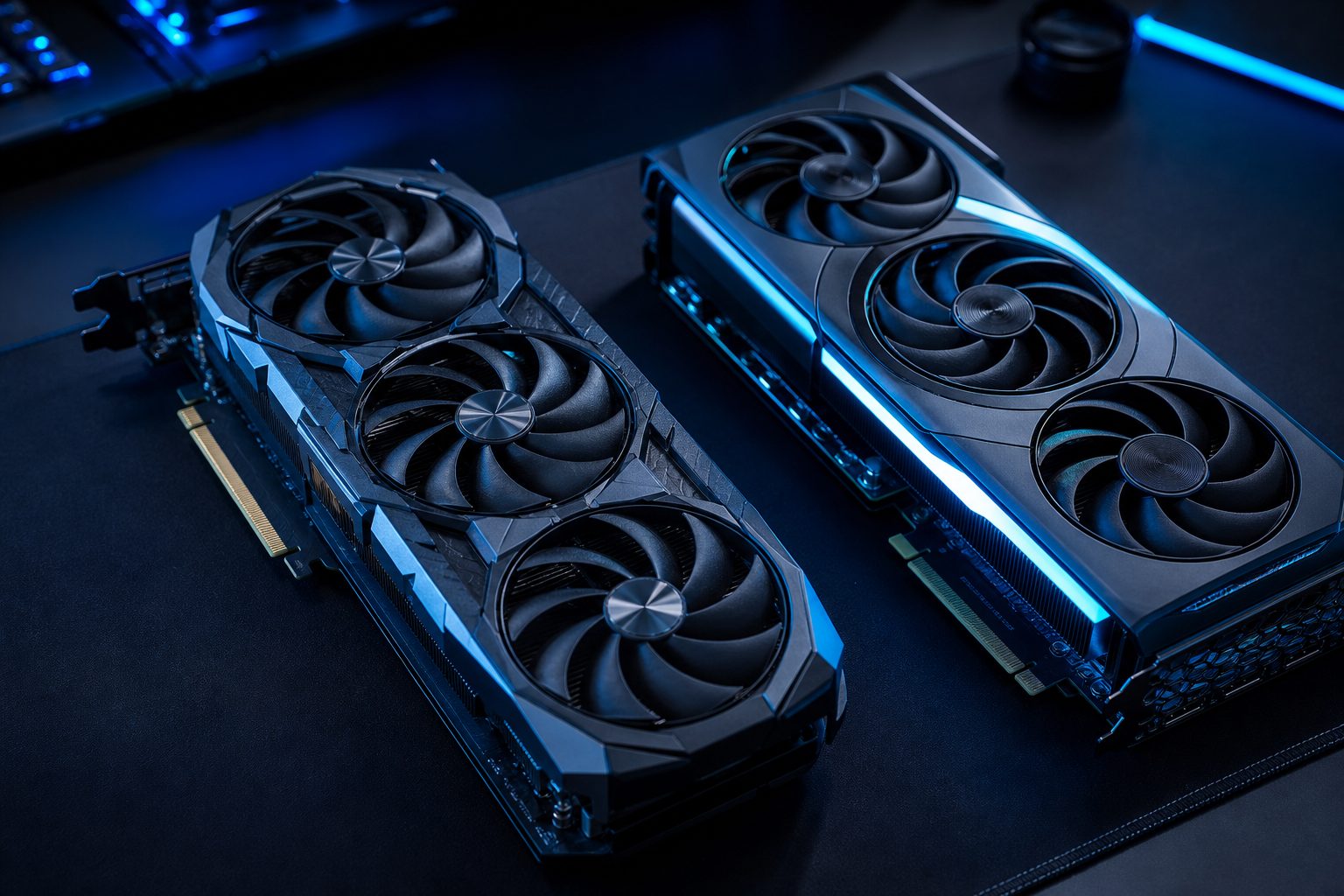
RTX 4060 vs RX 7600: The Best 1080p Graphics Card for Gamers
When building or upgrading a gaming PC, the choice of a 1080p graphics card is crucial, and the debate of RTX 4060 vs RX 7600 often takes center stage. Both cards target the mainstream market, promising solid performance for Full HD gaming without breaking the bank. Understanding their strengths and weaknesses is key to making an informed decision.
This comparison aims to provide a clear, practical breakdown of these two popular GPUs. It will cover their specifications, in-game performance, feature sets, and overall value. The goal is to help gamers determine which graphics card best suits their specific needs and budget for an optimal 1080p gaming experience.
A Closer Look at the RTX 4060 vs RX 7600 Specifications
Understanding the core specifications of each card is the first step in comparing the RTX 4060 vs RX 7600. While raw numbers do not tell the whole story, they provide a foundation for performance expectations. Both GPUs are designed with efficiency and modern gaming in mind, but they approach these goals from different architectural philosophies.
Examining the technical details helps to highlight the fundamental differences in their design. This includes aspects like memory configuration, power consumption, and the underlying silicon architecture. These factors directly influence how each card performs under various gaming loads.
NVIDIA GeForce RTX 4060 Overview
The NVIDIA GeForce RTX 4060 is built on the Ada Lovelace architecture, specifically utilizing the AD107 GPU. It features 3072 CUDA Cores and comes with 8GB of GDDR6 VRAM on a 128-bit memory bus. This configuration aims for efficiency and leverages NVIDIA’s advanced technologies.
Key strengths include its low power draw, typically around 115W, making it suitable for compact builds and systems with less robust power supplies. The RTX 4060 also brings support for DLSS 3, including Frame Generation, which can significantly boost frame rates in supported titles.
AMD Radeon RX 7600 Overview
The AMD Radeon RX 7600 uses the RDNA 3 architecture, specifically the Navi 33 XL GPU. It features 32 Compute Units, translating to 2048 Stream Processors, and also comes with 8GB of GDDR6 VRAM. However, its memory interface is also 128-bit, similar to the RTX 4060.
This card typically operates with a slightly higher Total Board Power (TBP) of 165W. The RX 7600 supports AMD’s FidelityFX Super Resolution (FSR) technology, which is compatible with a broader range of GPUs, including NVIDIA cards. It focuses on delivering strong rasterization performance for its price point.
1080p Gaming Performance Benchmarks
For most gamers considering an RTX 4060 vs RX 7600, raw gaming performance at 1080p is the most critical factor. Benchmarks in various titles provide a realistic picture of what to expect in real-world scenarios. It is important to look beyond synthetic tests and focus on actual gameplay frame rates.
Performance can vary significantly depending on the game, its engine, and specific graphical settings. Both cards are designed to offer a smooth experience at 1080p with high or ultra settings in most modern games. However, their strengths diverge when advanced features like ray tracing or upscaling are introduced.
Raw Gaming Performance
In traditional rasterization tests across a wide range of games, the RTX 4060 and RX 7600 often trade blows. Some titles may show the RX 7600 with a slight edge in average frames per second, while others favor the RTX 4060. The performance difference is typically within a narrow margin of 5-10% in most scenarios at 1080p high settings.
For example, in games like Cyberpunk 2077 or Alan Wake 2 without ray tracing, both cards deliver playable frame rates. Competitive titles such as CS2 or Valorant will run well above 144 FPS on either GPU, making them excellent choices for high-refresh-rate 1080p monitors.
Ray Tracing Capabilities
When it comes to ray tracing, the NVIDIA RTX 4060 generally holds a noticeable advantage over the AMD RX 7600. NVIDIA’s dedicated RT Cores are more efficient at handling ray tracing workloads, leading to better performance in games that heavily utilize this technology. While both cards can run ray tracing at 1080p, the RTX 4060 often provides a smoother experience.
For a truly immersive ray tracing experience at 1080p, the RTX 4060 is the stronger contender. The RX 7600 can enable ray tracing, but often requires significant compromises in settings or relies heavily on FSR to maintain playable frame rates.
Upscaling Technologies: DLSS 3 vs FSR 3
Upscaling technologies are crucial for boosting performance in demanding games. The RTX 4060 supports NVIDIA’s DLSS 3, which includes Frame Generation. This feature intelligently creates new frames between traditionally rendered ones, leading to significant FPS increases in supported titles. DLSS 3 is a powerful tool for extending the card’s longevity at 1080p.
The RX 7600 supports AMD’s FSR 3, which also includes Frame Generation. FSR is open-source and compatible with a wider range of GPUs, including older AMD and NVIDIA cards. While FSR 3 is improving, DLSS 3 with Frame Generation often offers superior image quality and performance, especially in early implementations.
Feature Set and Ecosystem Comparison
Beyond raw performance, the overall feature set and ecosystem are important considerations when comparing the RTX 4060 vs RX 7600. These aspects influence not only gaming but also other PC activities like streaming, content creation, and general system efficiency. Both NVIDIA and AMD offer unique software suites and hardware advantages.
Understanding these broader capabilities helps users choose a graphics card that aligns with their entire computing experience. From power efficiency to encoder quality, these details contribute to the overall value proposition of each GPU. The choice often extends beyond just frame rates.
Power Efficiency and Thermals
The RTX 4060 is notably more power-efficient than the RX 7600. With a typical board power of 115W compared to the RX 7600’s 165W, the RTX 4060 consumes less energy. This translates to lower electricity bills, less heat generated, and potentially quieter operation with smaller cooling solutions.
For users with older power supplies or those looking to build a compact, quiet system, the RTX 4060’s efficiency is a significant advantage. The RX 7600, while not power-hungry, requires a slightly more robust cooling setup and PSU.
Encoder Quality and Productivity
NVIDIA’s NVENC encoder, found in the RTX 4060, is widely regarded as superior for streaming and video recording. It offers excellent image quality with minimal performance impact, making it a favorite among content creators and streamers. The RTX 4060 also includes support for AV1 encoding, a modern video codec.
The RX 7600 features AMD’s RDNA 3 media engine, which also supports AV1 encoding and decoding. While AMD’s encoder has improved significantly, NVENC still holds an edge in terms of quality and widespread software integration. For dedicated streamers, the RTX 4060 presents a stronger option.
Price, Value, and Market Positioning
The final decision often comes down to price and the perceived value. Both the RTX 4060 and RX 7600 are positioned as mainstream 1080p graphics card options, but their pricing can fluctuate. Understanding their market value is essential for making a budget-conscious choice.
The MSRPs (Manufacturer’s Suggested Retail Prices) provide a baseline, but actual street prices can vary based on sales, availability, and specific AIB (Add-in-Board) partner models. Savvy shoppers will monitor pricing to secure the best deal. The overall value proposition considers not just the initial cost but also the features and performance delivered.
Current Pricing Trends
Historically, the RX 7600 has often been available at a slightly lower price point than the RTX 4060. This can make it an attractive option for budget-conscious gamers looking for the best raw performance per dollar. However, promotional deals and regional pricing can shift this balance.
It is advisable to check current retail prices from various vendors before making a purchase. The price difference might sometimes be negligible, making the feature set a more dominant deciding factor. Both cards regularly go on sale, so patience can be rewarded.
Value Proposition for 1080p Gamers
For gamers prioritizing pure rasterization performance at the lowest possible cost, the RX 7600 often offers a compelling value. It delivers excellent 1080p frame rates in most games, making it a solid choice for those who want to game without heavily relying on advanced features like ray tracing or DLSS Frame Generation.
The RTX 4060, while sometimes slightly more expensive, offers value through its superior ray tracing performance, DLSS 3 with Frame Generation, and better power efficiency. For users who value these NVIDIA-specific features and want a more future-proofed experience, the RTX 4060’s value proposition is strong.
Which 1080p Graphics Card Should You Buy?
The choice between the RTX 4060 vs RX 7600 ultimately depends on individual priorities and budget. Both are capable 1080p graphics card options that will provide a great gaming experience. There is no single ‘better’ card; rather, there is a card that is better suited for specific needs.
Consider what aspects of gaming and PC usage are most important. Are ray tracing and advanced upscaling technologies a must-have? Or is raw performance per dollar the primary concern? The answers to these questions will guide the decision.
Choose the RTX 4060 if…
- You prioritize ray tracing performance and image quality.
- You want the best upscaling technology with DLSS 3 Frame Generation.
- Power efficiency and lower heat generation are important for your build.
- You frequently stream or create content and value NVIDIA’s NVENC encoder.
- You are willing to pay a slight premium for NVIDIA’s ecosystem and features.
Opt for the RX 7600 if…
- Your budget is tighter, and you are looking for the best performance per dollar.
- You primarily care about raw rasterization performance in 1080p games.
- You are less concerned with ray tracing or prefer a more open upscaling standard like FSR.
- You have a power supply that can comfortably handle its 165W TBP.
- You want a solid, no-frills 1080p gaming experience without the NVIDIA premium.
Bottom line
The choice between an RTX 4060 vs RX 7600 for a 1080p graphics card is a nuanced one, with both offering compelling reasons for purchase. The RTX 4060 stands out for its superior ray tracing, DLSS 3 Frame Generation, and impressive power efficiency. It is an excellent option for those who prioritize advanced features and a more optimized NVIDIA ecosystem.
Conversely, the RX 7600 presents a strong value proposition for pure rasterization performance, often at a more attractive price point. It delivers solid 1080p gaming without the premium associated with NVIDIA’s exclusive features. Ultimately, the best card depends on individual gaming habits, budget, and feature preferences. For detailed compatibility checks with your favorite games, visit PCProfile and compare estimated FPS tables.
Frequently asked questions
What is the primary difference between the RTX 4060 vs RX 7600 for 1080p gaming?
The primary difference lies in their feature sets and specific performance strengths. The RTX 4060 excels in ray tracing and offers DLSS 3 with Frame Generation, while the RX 7600 often provides slightly better raw rasterization performance for its price point and supports AMD's FSR technology.
Does the RTX 4060 or RX 7600 have better ray tracing performance?
The RTX 4060 generally has better ray tracing performance due to NVIDIA's more mature and efficient RT Cores. While the RX 7600 can perform ray tracing, it often requires more significant compromises in settings or relies heavily on upscaling to maintain playable frame rates at 1080p.
Which 1080p graphics card is more power-efficient?
The NVIDIA RTX 4060 is significantly more power-efficient, with a typical board power of 115W. The AMD RX 7600 has a higher Total Board Power (TBP) of 165W, meaning it consumes more energy and generates more heat.
Is DLSS 3 or FSR 3 better for boosting performance with these cards?
DLSS 3 with Frame Generation, exclusive to the RTX 4060, is generally considered to offer superior image quality and performance boosts in supported titles. FSR 3, available on the RX 7600, is a good open-source alternative that works on more GPUs, but DLSS 3 often has an edge.
What is the typical price difference when comparing the RTX 4060 vs RX 7600?
Historically, the RX 7600 has often been priced slightly lower than the RTX 4060, making it a strong contender for budget-focused gamers. However, prices fluctuate frequently due to sales and market conditions, so current retail checks are always recommended.
Can both the RTX 4060 and RX 7600 handle high refresh rate 1080p gaming?
Yes, both the RTX 4060 and RX 7600 are capable of handling high refresh rate 1080p gaming in many titles, especially less demanding competitive games. For more graphically intensive AAA titles, achieving very high frame rates may require adjusting settings or utilizing upscaling technologies.
More in GPU Comparisons
The discussion around integrated vs dedicated graphics often centers on performance, especially when it comes to gaming. For many years, integrated GPUs.
Choosing the right graphics card for high-resolution gaming can be a significant decision, especially when targeting the popular 1440p sweet spot. The.